- Home
- /
- Finance App: From Accounting Data to Actionable Insight
 Reading time: 6 min
Giedrius Rumšys, Senior Consultant, The Infotrust

After eighteen months of development, we are proud to introduce The Infotrust Finance Intelligence App, a self-service analytics platform designed to transform accounting data into meaningful, actionable insights for finance teams.
Developed between September 2024 and March 2026, and co-funded by the European Union, the application was created to address a critical challenge in modern finance management: bridging the gap between the operational data generated by ERP systems and the strategic insight CFOs need to effectively oversee complex, multi-entity organizations.
The result is a finance intelligence solution that enables leadership teams to move beyond reporting and make faster, more informed decisions based on reliable financial data.
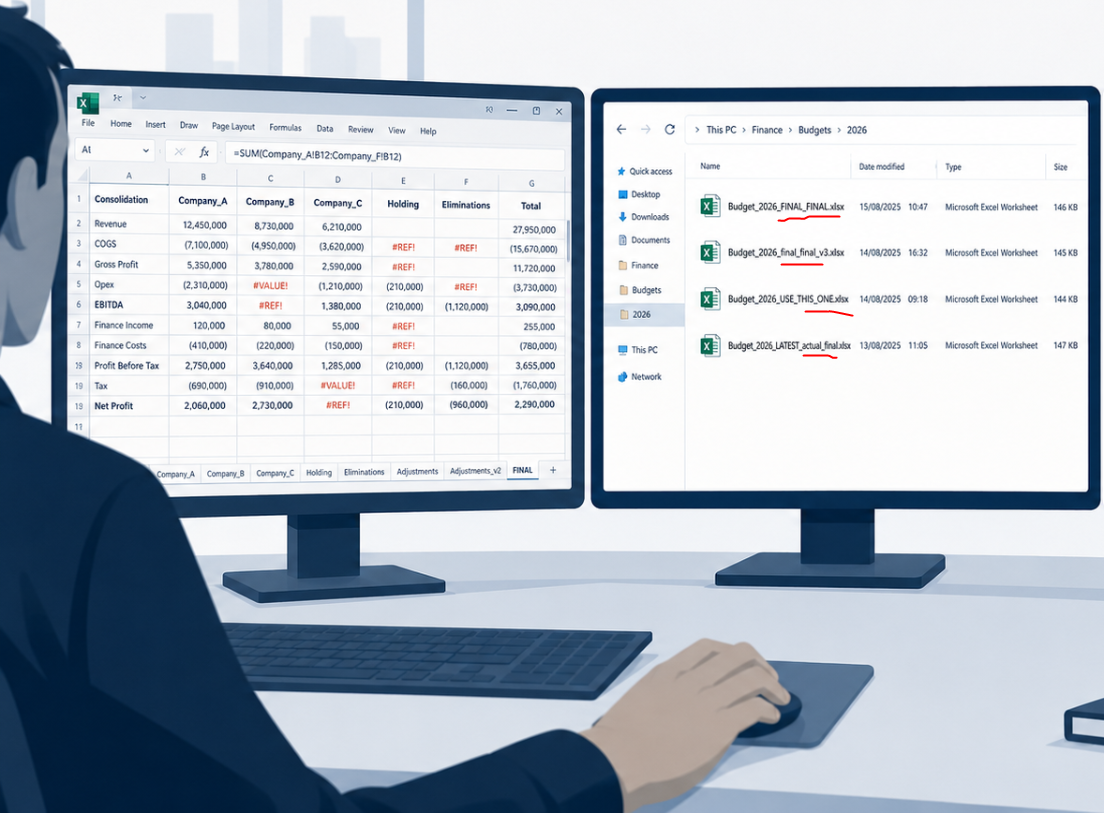
For finance leaders managing multi-entity organizations, the challenges are familiar. Each company in the group has its own ledger, often its own ERP system, and its own way of structuring accounts. Consolidation happens in spreadsheets. Budgets circulate through endless email threads and version-controlled files. Receivables are managed in one system, customer risk in another, if they are monitored at all. Bringing everything together becomes a manual, time-consuming process that places a constant burden on finance teams.
While ERP systems are essential for transaction processing and operational finance, they were never designed to solve every challenge at the group level. Most standard ERP platforms fall short when it comes to multi-entity consolidation, structured budgeting and forecasting, customized group reporting, and proactive debt management supported by external risk intelligence.
Our goal was to close that gap. Rather than replacing the ERP, we built a complementary intelligence layer that sits on top of existing systems, extending their capabilities and giving finance teams the visibility, control, and decision-making support they need, without custom development or technical complexity.
The application is built around two integrated modules that operate on a shared data model and common access framework. This ensures consistency across workflows, a single source of truth for financial data, and secure, role-based access for every user.
The FIN App serves as the consolidation and planning hub. It extracts financial data, including the general ledger, accounts receivable, and accounts payable, from each company within the group and consolidates it under a unified chart of accounts and reporting structure.
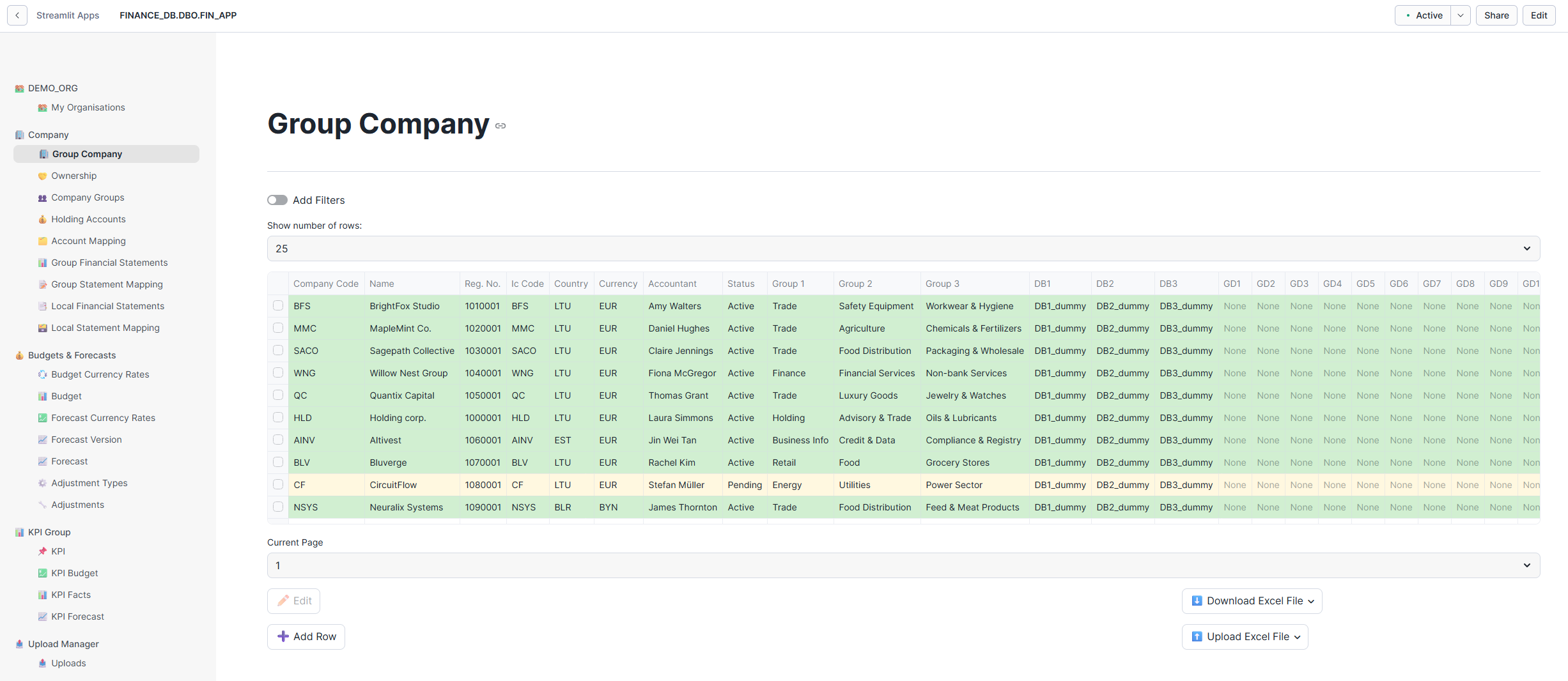
Defining group structure and company hierarchy
Finance teams can design their own reports, including P&L statements, balance sheets, KPI dashboards, and cash flow reports, define mapping rules from local accounts to group-level accounts, and analyze the results through their preferred business intelligence tools, including Qlik, Microsoft Power BI, Tableau, or Looker.
Budgeting and forecasting are managed within the same environment. Users can create, submit, and version budgets, and upload data using Excel templates with full validation, including foreign-key checks and error rollback.
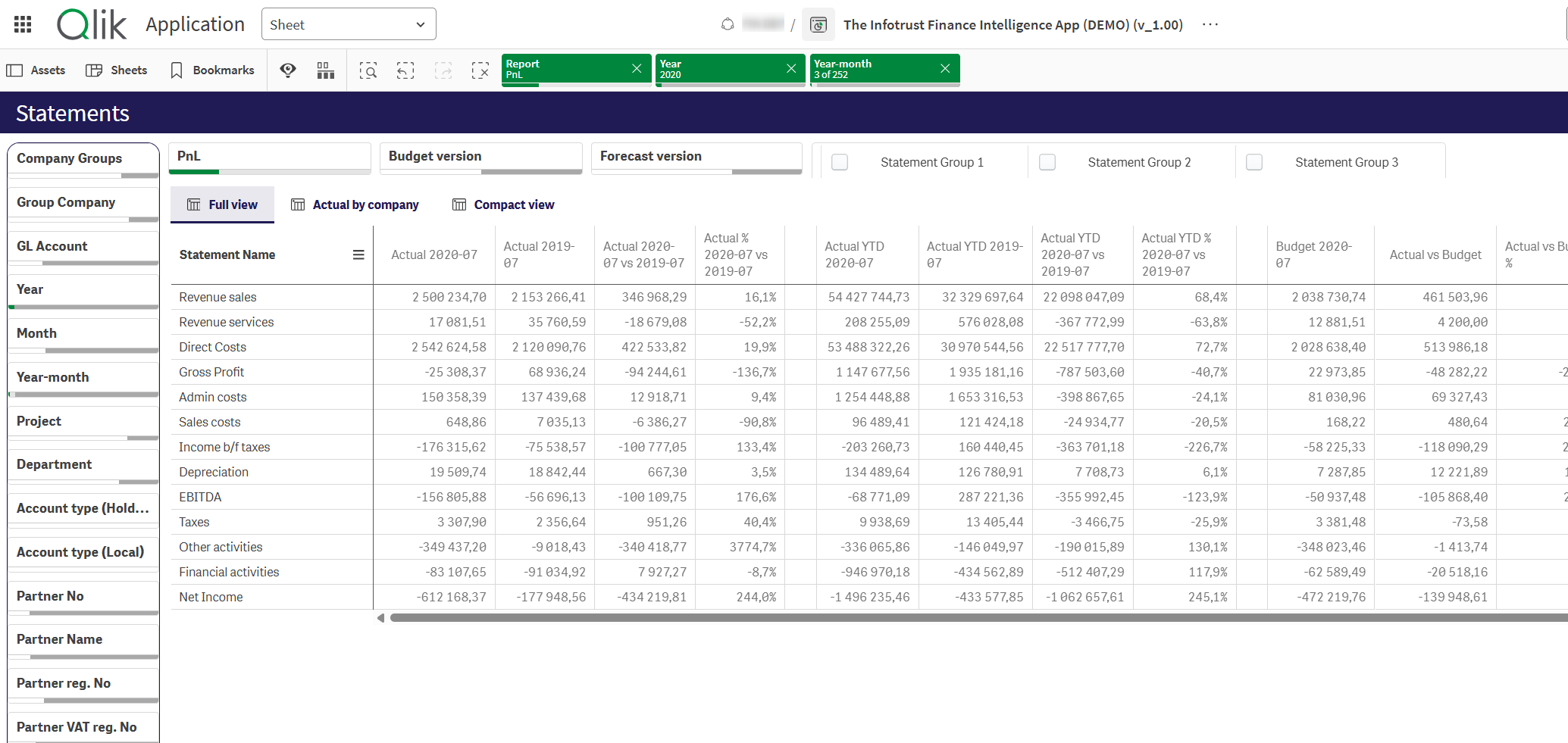
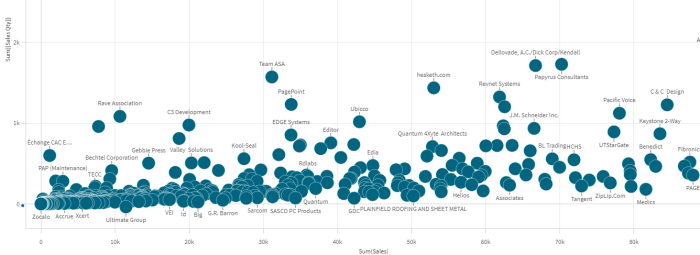
P&L report in Qlik Cloud Analytics
The system also supports the inclusion of non-financial KPIs alongside financial data, such as headcount, contract volumes, FTE reporting, and environmental or sustainability metrics. All information is maintained within a unified structure, enabling direct, like-for-like comparison between forecasts, budget versions, and actual results.
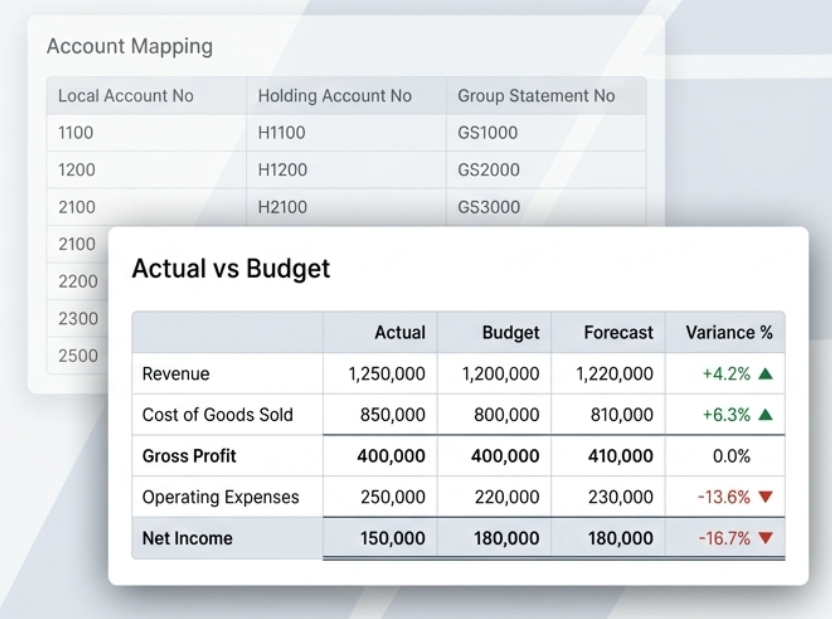
Local and holding accounts mapping enables unified actual vs budget comparison
The consolidation logic is one of the features finance teams value most. Group structures are defined directly within the application, and internal transactions are flagged at the transaction level rather than only at the company level.
As a result, switching between different consolidation views, for example, viewing an entity as part of the group versus on a standalone basis, takes a single click, rather than triggering a recalculation cycle.
The Debts Module manages the operational side of customer receivables and credit risk. Finance teams can define their own workflows, specifying rules such as when a debt becomes 16 days overdue, send an email reminder; at 30 days, switch to a more formal template; and at 45 days, escalate the case into a task for the responsible account manager.
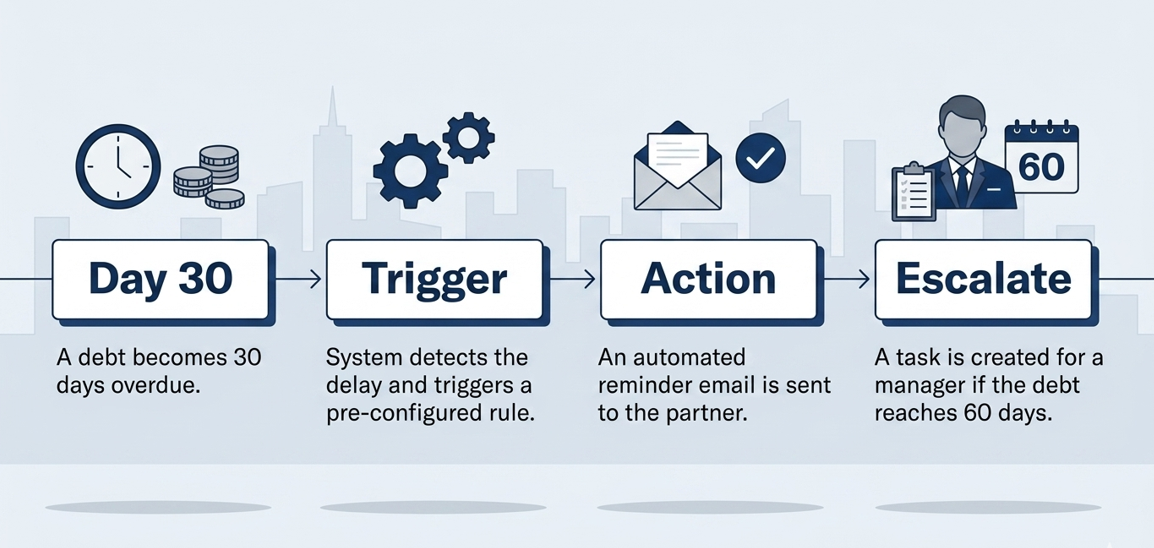
Debts module process schema example
Communication templates can be configured as plain text, formatted HTML, or SMS, and can include dynamic variables such as customer details, invoice or document numbers, and summaries of outstanding positions.
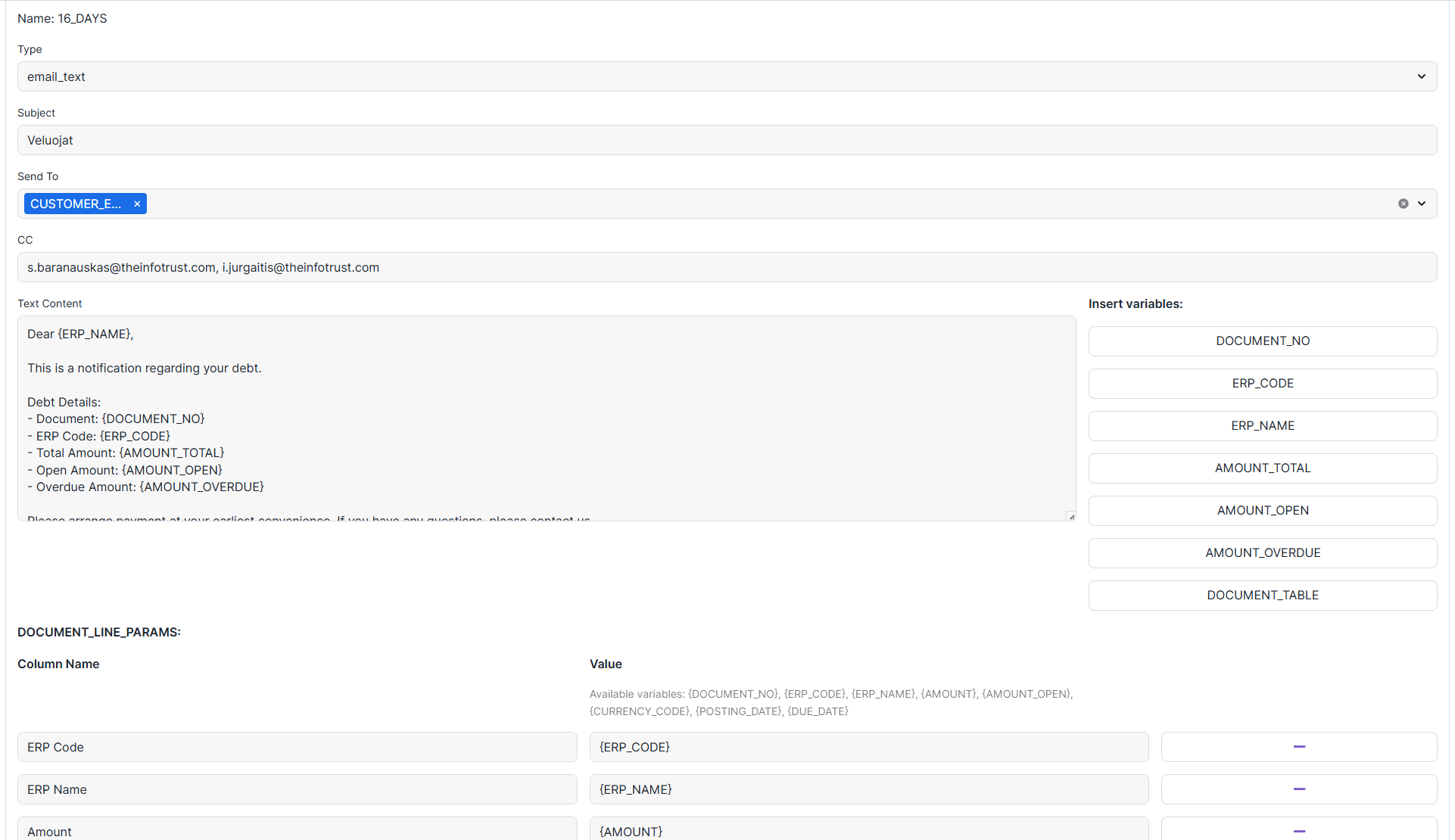
Email and sms template configuration tool
Different customer segments can follow different workflows. For example, VIP customers may receive polite, informational reminders, while late-stage accounts follow a more assertive escalation path. All rules, triggers, and templates are fully managed within the application by finance users, without requiring IT support.
In addition, the Debts Module includes a risk intelligence layer that continuously monitors customers and partners using Lithuanian public data sources, including the Registry Centre, court filings, and Statistics Lithuania. Whenever a customer has an outstanding balance, the finance team is automatically subscribed to alerts about that customer, with notifications covering key events such as bankruptcy filings, changes in legal name or address, submission of new financial statements, missed tax filings, or significant shifts in financial performance.
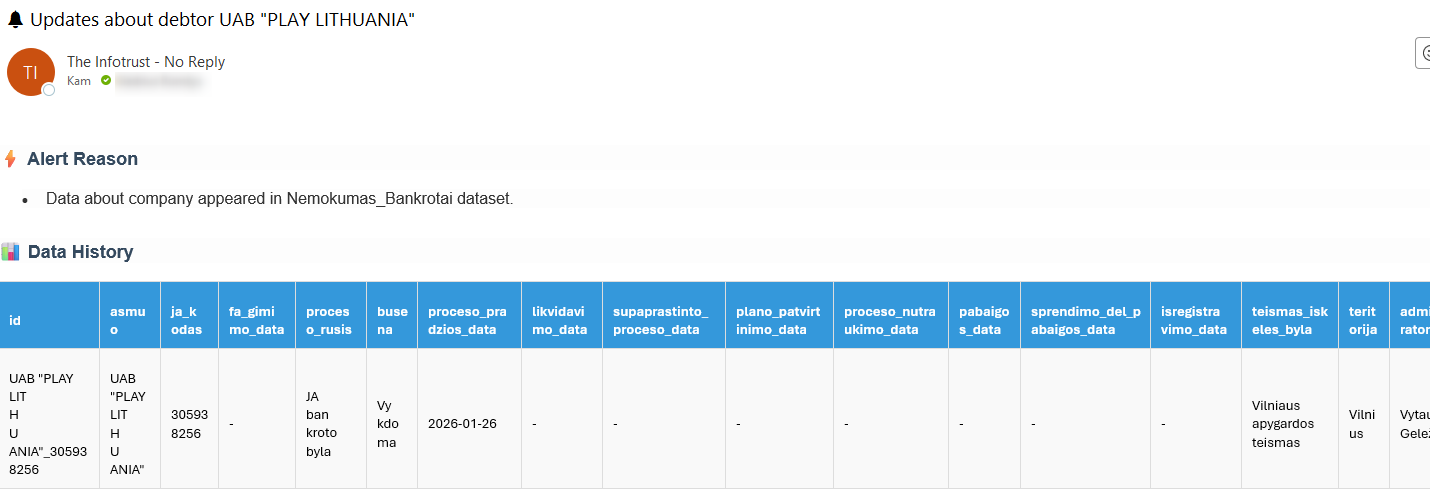
Email example: a client appeared on the national insolvency list
For example, a bankruptcy filing recorded on January 26th would trigger an automated notification on January 27th, transforming what was previously a periodic review process into a continuous, early-warning risk monitoring system.
A core principle of the project is that finance professionals should not depend on IT to make changes. Whether adding a new company to a consolidation scope, adjusting a chart of accounts mapping, designing a new financial statement, or configuring a notification rule, everything is managed directly within the application by finance users, without requiring developer involvement.
Excel is treated as a first-class interface rather than a legacy format to be replaced. Every table in the system can be exported to Excel, edited in bulk, and re-imported. Behind the scenes, hidden ID fields ensure the system can distinguish between updates and new records.
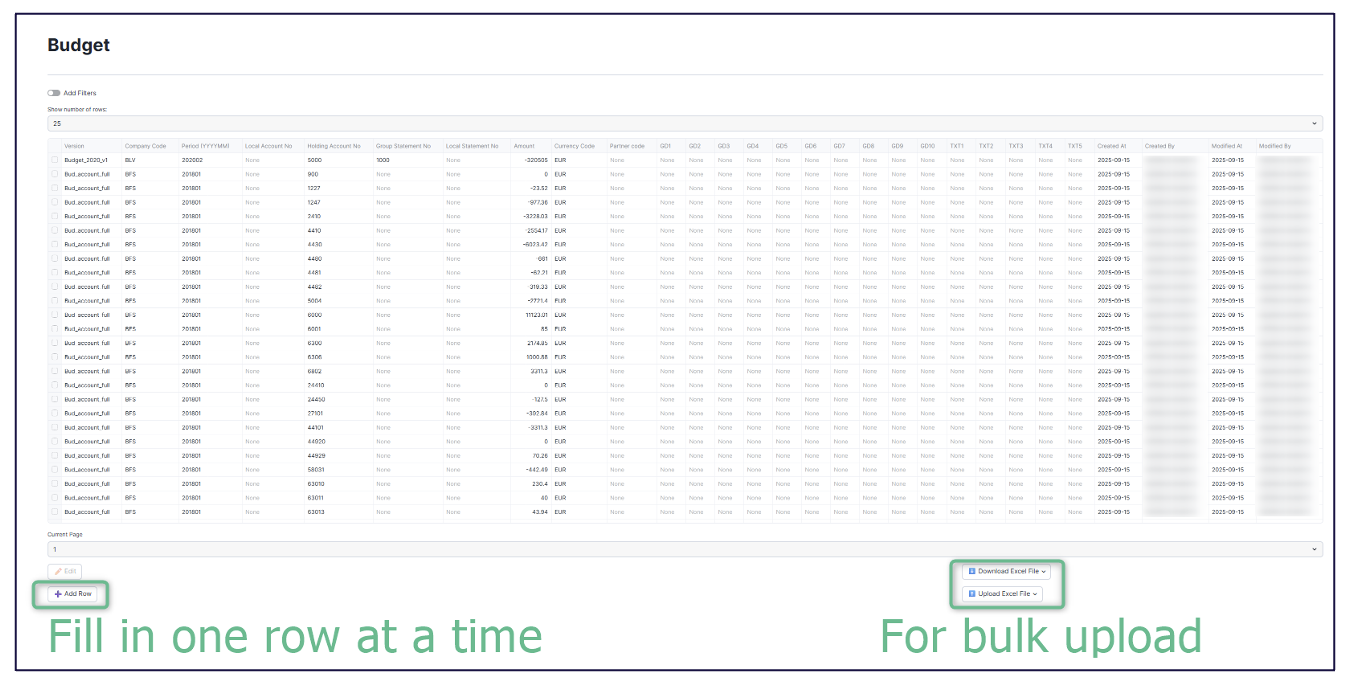
Enter budget either one row at a time or many rows with Excel upload
Before any data is written back, the Excel import layer performs strict validation, including foreign-key integrity checks to ensure relationships between tables remain consistent, as well as role-based permission checks across all affected data.
Excel uploads cannot be used to bypass the security model. Any issues are clearly reported to the user, and failed imports are fully rolled back to maintain data integrity.
The Finance Intelligence App is built on Snowflake, with Streamlit used to deliver two dedicated user interfaces for the financial consolidation and debt management modules.
Snowflake serves as the central data engine for storage, transformation, and modeling, producing a curated “Gold” data layer that forms the foundation for downstream analytics. This layer is then consumed by business intelligence tools such as Qlik Cloud Analytics and Microsoft Power BI.
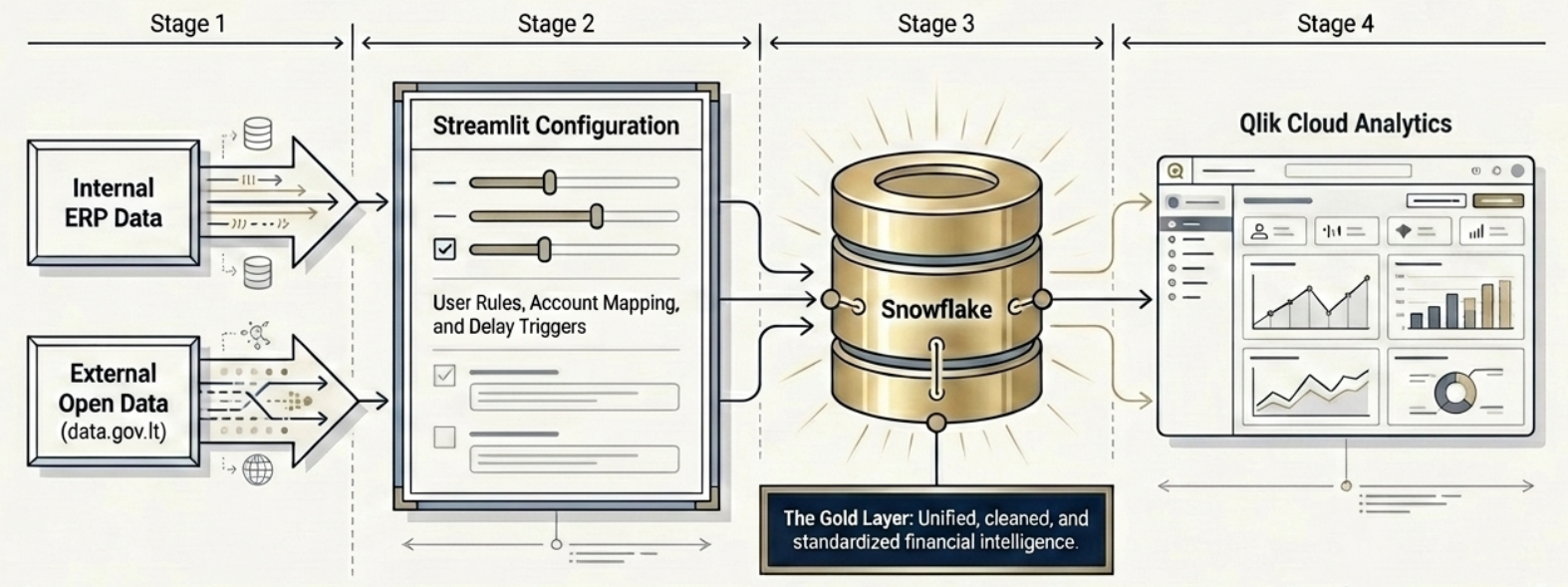
Architecture of the gold layer in Snowflake
While most components are fully integrated within Snowflake, the open-data ingestion service is deployed separately as a Docker container on Microsoft Azure. This design provides the flexibility required to interact with external APIs and retrieve data from Lithuanian public registries, including scraping and structured data extraction where needed.
The application’s codebase is built on shared foundations, ensuring that data models, validation logic, and access rules are defined once and reused consistently across all procedures and services, preserving data integrity end to end.
System evolution is managed through a custom migration framework that safely handles schema changes as the application evolves, allowing the platform to scale without compromising stability or consistency.
To ensure reliability, the development team maintains separate Development, UAT, and Production environments, all synchronized through GitHub Actions. This CI/CD pipeline automatically deploys all application layers, including Streamlit applications, stored procedures, container services, secrets, and role configurations, whenever changes are merged into the main codebase.
Finally, the architecture is designed to be database-agnostic, enabling the same application logic to run on both Snowflake and PostgreSQL with only minimal configuration changes.
The Finance Intelligence App is designed for groups of companies operating multiple legal entities, often across several ERP systems, where consolidation and reporting complexity becomes a structural challenge rather than a tooling issue.
It is particularly well-suited for organizations with high-volume billing operations, such as utilities, telecommunications, insurance providers, and service companies processing thousands of invoices each month, where automated debt management and structured receivables workflows deliver immediate operational value.
For existing business intelligence users, the platform addresses a gap that traditional analytics tools cannot solve on their own. While BI platforms explain what has happened, this application enables finance teams to actively manage the underlying drivers of those results, such as mappings, budgets, parameters, and operational workflows, with built-in access control, version history, and full audit traceability.
We are actively expanding the platform with additional modules and capabilities, including allocations, asset management, CapEx planning, AML compliance checks, and broader open-data integrations across the Baltics and beyond.
The architecture has been designed with this expansion in mind, and the core foundations for group consolidation, budgeting, and receivables management are already in production.
If you are responsible for finance in a multi-entity organization and recognize the challenges described above, slow consolidation cycles, budgeting managed through versioned spreadsheets, or customer risk that is only identified after the fact, we would be glad to show you what the platform can do.
Please get in touch through our website to arrange a demonstration.